










Bollywood’s relationship with India’s landscape is as much a part of the industry’s identity as its music, its stars, or its characteristic emotional register. For nearly a century, Hindi cinema has been drawing audiences into specific places — the golden dunes of Rajasthan, the colonial bungalows of hill stations, the beaches of Goa, the ghats of Varanasi — creating a cinematic geography of India that has, in many cases, shaped tourism flows more directly than any government campaign. Visiting these locations is not merely film tourism but an encounter with the specifically Indian cultural significance that cinema and landscape have jointly produced.

Chapora Fort, Goa — Dil Chahta Hai (2001)
Few locations in Indian cinema history carry the specific emotional freight of Chapora Fort’s panoramic terrace overlooking the confluence of the Chapora River and the Arabian Sea, where Aamir Khan, Saif Ali Khan, and Akshaye Khanna posed for the photograph that became Dil Chahta Hai’s defining image. The scene’s significance in Indian popular culture extends well beyond its film context — it became an aspirational shorthand for a certain kind of friendship and freedom among a generation of young urban Indians who grew up with the film as a touchstone.
The fort itself, a seventeenth-century Portuguese-built structure on a promontory above Vagator Beach in North Goa, was already a significant historical site before Farhan Akhtar’s film embedded it permanently in collective memory. Getting there requires a short climb from the road — most visitors to the area make the fifteen-minute walk up the laterite path regardless of their Bollywood associations, attracted simply by the view. Those who arrive knowing the film find a landscape that genuinely justifies the photograph that made it famous.
Pangong Tso, Ladakh — 3 Idiots (2009)
The statistics on how dramatically Pangong Tso’s tourist volumes changed after 3 Idiots are almost impossible to believe: the lake that was known primarily to adventure travellers and serious trekkers before 2009 became, within two or three years of the film’s release, one of India’s most photographed locations, requiring the Ladakh administration to implement permit systems and traffic management that hadn’t previously been necessary at a site this remote.
The lake’s appearance in the film’s finale — Aamir Khan cycling along the shore as Kareena Kapoor arrives — captures something genuine about the place’s quality of light and colour that makes the scene’s location choice feel inevitable in retrospect. Pangong Tso at 4,350 metres altitude is a high-altitude salt lake that extends across the India-China border, its water shifting through colours from bright turquoise near the shore to deep blue at the centre, against a backdrop of brown-red mountains that the altitude strips of any vegetation. It is, simply, one of the most extraordinary landscapes in Asia, and the film chose well.
Visiting today requires an Inner Line Permit from the Leh district administration, which is straightforward to arrange. The lakeside camp accommodation that has sprung up to handle the post-film tourism surge ranges from basic tents to surprisingly comfortable glamping setups, with an overnight stay producing the sunrise views over the lake that most photographs don’t quite capture.
Jab We Met Locations — Shimla and Bathinda
Imtiaz Ali’s 2007 romantic film took audiences through several of North India’s most recognisable railway infrastructure, and the specific stations it made famous continue drawing visitors who arrive looking for the platforms where Kareena Kapoor’s Geet commandeered Shahid Kapoor’s Aditya into her chaotic life. Bathinda Railway Station in Punjab, where several key scenes were filmed, remains a working station whose everyday functionality makes finding the filmed spaces a genuine treasure hunt among the platform crowds rather than a sanitised movie-set experience.
Shimla’s contribution to the film’s visual vocabulary is more diffuse — the hill station’s colonial architecture, its winding Mall Road, and the specific quality of winter light that the crew captured during the film’s Shimla sequences have all become part of the reason Shimla remains on every North India hill station itinerary. The Jakhu Temple above the town, which appears briefly, offers the best panoramic view of Shimla’s rooftop geography from above — an angle the town rarely shows at ground level.
DDLJ Punjab — Dilwale Dulhania Le Jayenge (1995)
The most iconic single image in Bollywood’s location history — Kajol running through the mustard fields of Punjab toward Shah Rukh Khan’s outstretched hand — has become so thoroughly embedded in Indian popular culture that visiting Punjab’s agricultural heartland during the mustard flowering season in February and March feels like walking into a scene that exists simultaneously in geography and memory. The specific fields where the sequence was filmed are not precisely mapped or officially marked, which is in some ways appropriate — the image belongs to Punjab as a whole rather than to any single location, and the mustard bloom that produces it occurs across the state’s farming landscape without requiring pilgrimage to any particular spot.
Rajasthan — Bollywood’s Most Versatile Setting
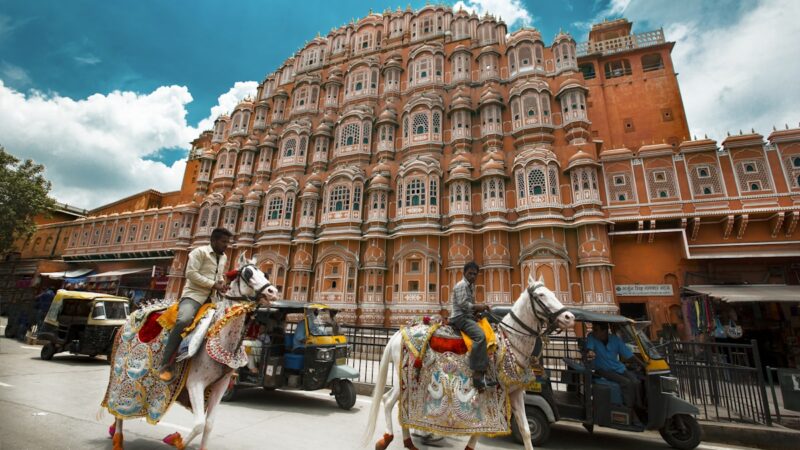
No Indian state has appeared in more Bollywood films than Rajasthan, whose combination of desert landscape, medieval fort architecture, and painterly colour makes it the default visual shorthand for grandeur, romance, and historical epic simultaneously. Jodhpur’s Mehrangarh Fort has appeared in dozens of films including Mughal-e-Azam (partially), The Dark Knight Rises (as a prison), and multiple contemporary Bollywood productions. Jaisalmer’s golden sandstone Sonar Fort has been used as a setting across genres from thriller to romance. Udaipur’s Lake Palace, used for the James Bond film Octopussy, continues drawing visitors who want the view from the jetty that the film established as one of India’s most glamorous visual frames.
Planning Bollywood Location Travel
Several practical considerations make Bollywood location travel more rewarding than simply showing up at famous spots. Timing matters significantly — Pangong Tso is accessible only between May and October, Rajasthan is most comfortable between October and March, and Punjab’s mustard bloom happens in a specific six-week window in February and March that overlaps very briefly with the winter cold that makes the landscape most atmospheric.
Several tour operators across major Indian cities now run dedicated Bollywood location tours — particularly in Rajasthan and Goa — that combine filming history with deeper local context and practical logistics. These tours are uneven in quality but the best of them add considerably to the experience by explaining not just where scenes were filmed but the production decisions and local negotiations that placed them there.
Conclusion
Bollywood’s filming locations are among India’s most unexpected travel guides — a century of filmmakers choosing the country’s most visually extraordinary places has produced an informal map of Indian landscape at its most spectacular. Following that map, from Goa’s fort to Ladakh’s lake to Rajasthan’s forts and Punjab’s fields, is both a journey into Indian cinema history and a genuinely rewarding encounter with the country’s extraordinary physical diversity. The films and the places illuminate each other in ways that neither delivers alone.
Visiting Respectfully
Many of these locations are functioning towns, forts, and beaches with their own local communities, not theme parks built for fans. Visiting respectfully, supporting local businesses rather than treating a site purely as a photo backdrop, keeps these spots welcoming for both residents and future visitors.