













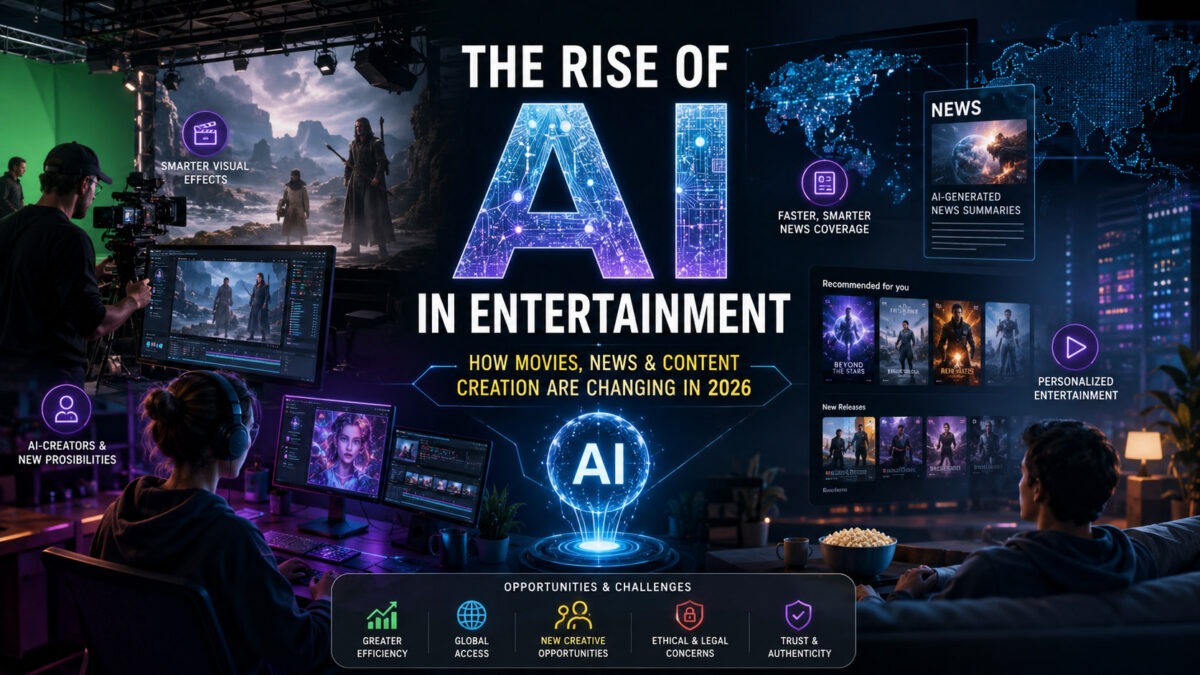
For years, the entertainment industry treated artificial intelligence as a story to sell.
Hollywood imagined sentient machines. Newsrooms debated algorithmic futures. Creators joked that software would never replace originality.
In 2026, that conversation looks outdated.
AI is no longer a futuristic concept sitting outside entertainment—it has quietly become part of the infrastructure behind it.
Films are being planned with predictive analytics. Newsrooms are experimenting with AI-assisted publishing. Independent creators are producing content at a scale that once required agencies and studios. Recommendation systems increasingly decide what audiences watch before they consciously choose it.
Yet despite the hype, the biggest shift is not that AI is replacing creativity.
It is changing the economics of creativity.
The question is no longer whether AI belongs in entertainment. The real question is who benefits from it—and what audiences gain or lose in the process.
Entertainment Has Entered Its Efficiency Era
Every major media transformation begins with a promise.
Television promised accessibility. Streaming promised convenience. Social media promised democratization.
AI promises efficiency.
That promise matters because entertainment has become increasingly expensive to produce and increasingly difficult to monetize.
Studios face rising production budgets.
Publishers fight shrinking attention spans.
Creators compete in an environment where consistency often matters as much as quality.
AI arrives at exactly the moment industries are under pressure to produce more content, faster.
That makes adoption less ideological and more economic.
A filmmaker reducing editing time by 30%.
A publisher automating routine workflows.
A creator turning one video into ten pieces of content.
Those gains add up.
But efficiency changes incentives—and incentives eventually reshape culture.
Hollywood’s Relationship With AI Is Becoming More Practical
Popular discussion often frames AI in cinema as robots writing scripts or generating actors.
Reality looks less dramatic.
The film industry’s use of AI has become increasingly operational.
Studios are exploring AI across three major areas:
Development
Studios already work with audience data and forecasting tools. AI expands that process.
Executives can analyze historical performance patterns, compare genre trends, evaluate audience retention signals, and identify commercial opportunities before greenlighting projects.
That does not mean algorithms decide what gets made.
But data increasingly influences which stories appear financially safer.
Production
This is where AI’s impact is becoming more visible.
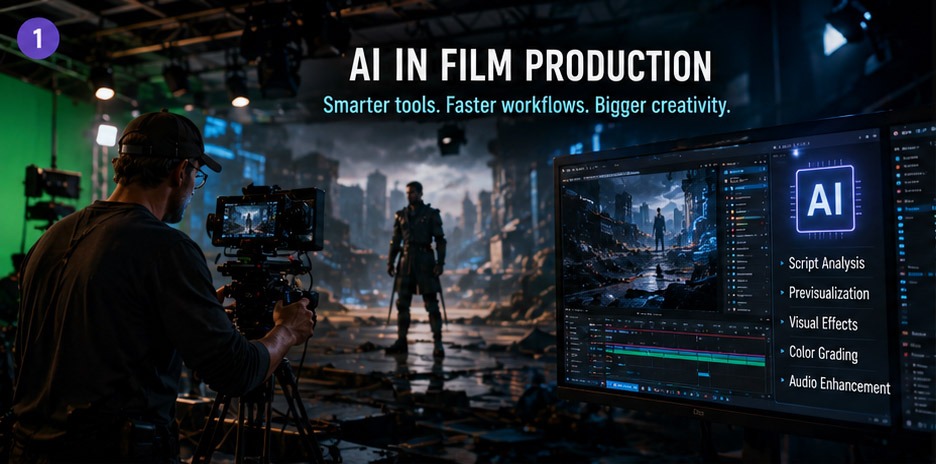
Tasks once requiring large post-production teams can now be accelerated through machine-assisted workflows:
- Pre-visualization
- Scene composition
- Motion cleanup
- Dialogue processing
- Environment generation
- Localization
Virtual production environments continue reducing dependence on physical sets while allowing creative teams to iterate faster.
Post-Production
Editing remains one of the most time-intensive stages of filmmaking.
AI tools increasingly help organize footage, identify usable takes, generate subtitles, assist with sound balancing, and shorten repetitive editing cycles.
The result is not necessarily fewer filmmakers.
It may mean smaller teams creating work that previously required much larger operations.
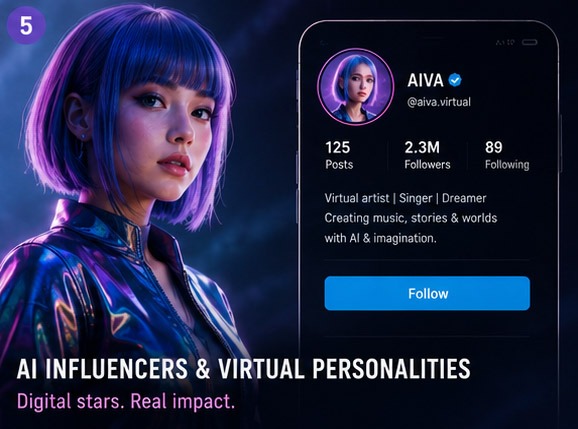
The Creator Economy Is Becoming a Competitive Threat to Traditional Media
One of the most underestimated consequences of AI is not what it does for large studios.
It is what it enables for individuals.
A decade ago, creators needed production teams.
Today, many operate like compact media companies.
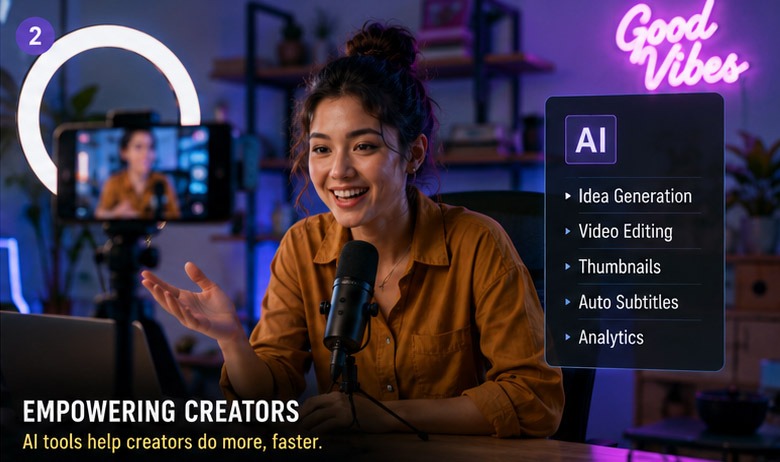
A creator can research trends in the morning, record content in the afternoon, edit with AI assistance, generate promotional assets, distribute across platforms, and analyze performance by evening.
The barrier between independent creator and media publisher continues shrinking.
This shift matters because audiences increasingly follow people instead of institutions.
Viewers trust recognizable personalities.
Readers subscribe to individuals.
Entertainment consumption has become more relationship-driven.
AI accelerates that transition.
The challenge for creators, however, is becoming obvious.
If everyone gains access to the same tools, output becomes abundant.
Attention becomes scarce.
News Media Faces a More Complicated Future
News organizations have perhaps the most difficult relationship with AI.
Unlike entertainment, journalism depends heavily on trust.
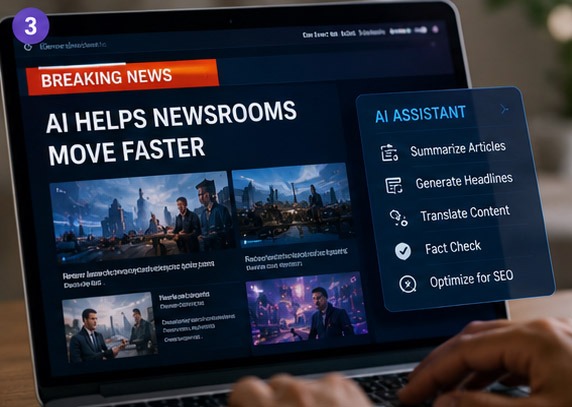
Publishers increasingly use AI for:
- Content formatting
- Translation
- Breaking-news summaries
- Search optimization
- Social publishing
- Internal research support
These applications improve operational speed.
But they also expose uncomfortable questions.
If news becomes easier to publish, does quality improve—or does volume simply increase?
Readers already operate in an environment flooded with headlines.
AI introduces the possibility of information abundance combined with declining confidence.
This tension may become one of media’s defining challenges.
Speed creates reach.
Trust creates longevity.
The organizations that balance both may be the ones that endure.
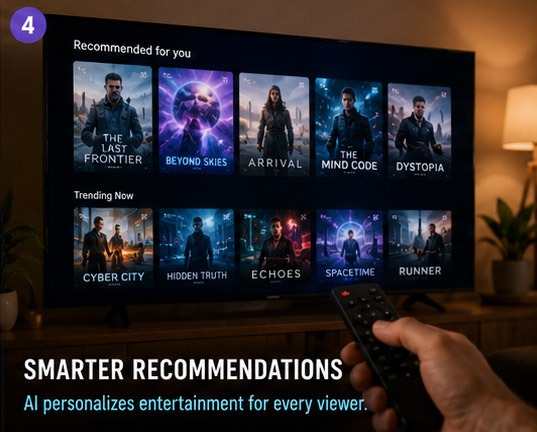
Recommendation Algorithms Are Becoming Invisible Editors
Most audiences still believe they choose what they watch.
Increasingly, they choose from what platforms decide to show.
Entertainment in 2026 is shaped less by gatekeepers and more by recommendation systems.
Streaming platforms determine visibility.
Short-form platforms reward retention.
Search algorithms influence discovery.
In practical terms, audiences rarely consume entertainment in a neutral environment.
They consume within systems optimized for engagement.
AI strengthens this dynamic.
Two viewers can open the same app and experience entirely different realities.
Different headlines.
Different creators.
Different cultural moments.
Personalization improves convenience.
But it may also reduce shared experiences.
Entertainment historically created common conversations.
Algorithms increasingly create individualized ones.
AI Content Is Improving Faster Than Audience Expectations
One reason AI has spread so quickly is simple:
Audiences care more about experience than production methods.
Most viewers judge content based on:
- Relevance
- Entertainment value
- Production quality
- Emotional impact
Not whether a workflow included automation.
That creates pressure across industries.
If consumers accept AI-assisted content without resistance, adoption accelerates.
But acceptance has limits.
Audiences still react negatively to experiences that feel synthetic, repetitive, or emotionally empty.
Technology can scale production.
It cannot guarantee meaning.
The New Premium Is Human Perspective
As content volume increases, originality becomes more valuable—not less.
This may become the biggest misunderstanding about AI.
People often assume automation reduces the importance of human creators.
History suggests the opposite.
When production becomes easier:
Taste matters more.
Judgment matters more.
Voice matters more.
Audiences stop paying for access and start paying for interpretation.
That creates opportunity.
Writers who develop distinctive perspectives.
Filmmakers who create recognizable identities.
Creators who build communities instead of chasing output.
Those advantages become harder—not easier—to automate.
The Industry’s Unfinished Questions
Entertainment has moved faster than its rules.
Major debates remain unresolved.
Ownership
Who owns AI-assisted creative work?
Compensation
Should training data contributors receive recognition?
Authenticity
Should audiences know when content includes AI generation?
Employment
Will workflows eliminate jobs—or redefine them?
History suggests technology rarely removes entire industries.
But it often redistributes influence.
That process is already underway.
What Changes for Audiences?
For audiences, the future may feel deceptively familiar.
Movies will still arrive.
Creators will still post.
News will still update.
But beneath the surface, the systems creating and delivering those experiences will look increasingly different.
Viewers may gain:
- More personalization
- Faster content cycles
- Global access
- Better localization
At the same time, audiences may need stronger media literacy.
Understanding how content is produced could become as important as understanding the content itself.
Final Thoughts
Entertainment is not becoming less human.
It is becoming more assisted.
AI is reducing friction across production, distribution, and discovery—but technology alone does not create culture.
People still respond to stories because they reveal something human: ambition, fear, identity, conflict, connection.
That remains difficult to automate.
The entertainment industry in 2026 is not witnessing the end of creativity.
It is witnessing a renegotiation of how creativity gets made, distributed, and valued.
And that conversation has only begun.